What the Frass!
By: Stefan Braun
At my local bee club’s last meeting we discussed hive autopsies. Which is a poignant subject this time of year, especially if winter monitoring has lapsed. Basically the gist of the meeting was that every one loses colonies and the only failure is not learning from it. One thing I hear said over and over again is that “it,” as in what killed the colony, is always varroa mites. I have been guilty of this mantra myself. Because of all the hive autopsies I have performed, I can only think of a handful where mites did not contribute to the loss . Before varroa, the natural attrition of managed colonies ranged in the 10 to 15 percent. Last year in the US some states saw losses as high as 70 percent of managed colonies. So it is safe to assume varroa mites play a role in any colony's demise.
I am sure we are all familiar with what every high school Ag teacher will proclaim about assuming. So, how do we ensure we are not an ass. The easiest diagnostic tool to determine the hand varroa has played is looking for varroa frass on the comb. Frass is what the science hippies call insect poop. Much as humans benefit from not playing in their poo, varroa do the same by depositing waste in one location in the cell. In a strong active colony with 10s of thousands of workers it is unlikely to come across varroa frass because of honey bees’ regular cleaning habits. As the hive dwindles though, the varroa frass builds up at the top of the cell. Varroa mite frass is white in color and looks like someone piled bits of paint overspray.
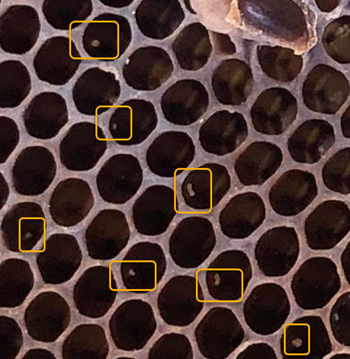
While holding the frame by the tabs twist the frame so you are looking from the bottom edge towards the top. Now you can focus on the inside tops of the brood cells. To determine the level of influence varroa had we evaluate how much frass is in the cells. It would be unlikely to not find frass on a few cells of a dead colony. If you are finding frass in the majority of the brood comb cells, varroa is likely the vector that led to the colony’s death.
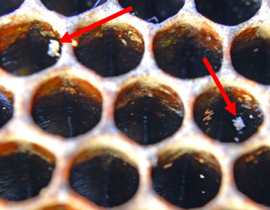
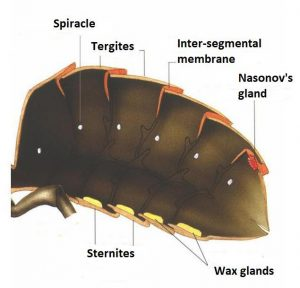
You may have noticed the specificity of frass in the brood comb. That is because sometimes granulated honey can look like frass. The bees lick away all the liquid when honey crystalizes. This leaves little white grains that can be mistaken for frass, but usually collects on the bottom of honey comb cells. Also, the grains will usually tip out of the comb. Why does all of this matter? Well, varroa is a vector for over 21 known ailments. When a colony carries a high mite load they are combating ailments that are normally relatively harmless. This is because honey bees have resistance to the vectors these ailments evolved to exploit. But mites provide a relatively new vector point for these ailments between the sternites. The vector varroa introduces is where the varroa pierces the bee to feed on its fatbodies. This is a double whammy because the fatbodies of the honey bee act as an immune system. If you want to geek out on varroa look up any of the research done by Samuel Ramsey. He discovered varroa feed on fatbodies explaining the immuno-complications varroa present.
If you are new to beekeeping or an old soul it may seem like everyone is harping about varroa. Well, that is because varroa have been the single most detrimental threat in the US to the honey bees since its introduction in the 80s or 90s. Plus, management of all hive ailments and conditions are easier for the bees and the beekeeper if the mite loads are kept to nominal levels. That is why testing and appropriate treatment for varroa provides the hive with the greatest chances of survival. In beekeeping currently everything is linked to varroa. At least until the next mite finds its way to our shores.